

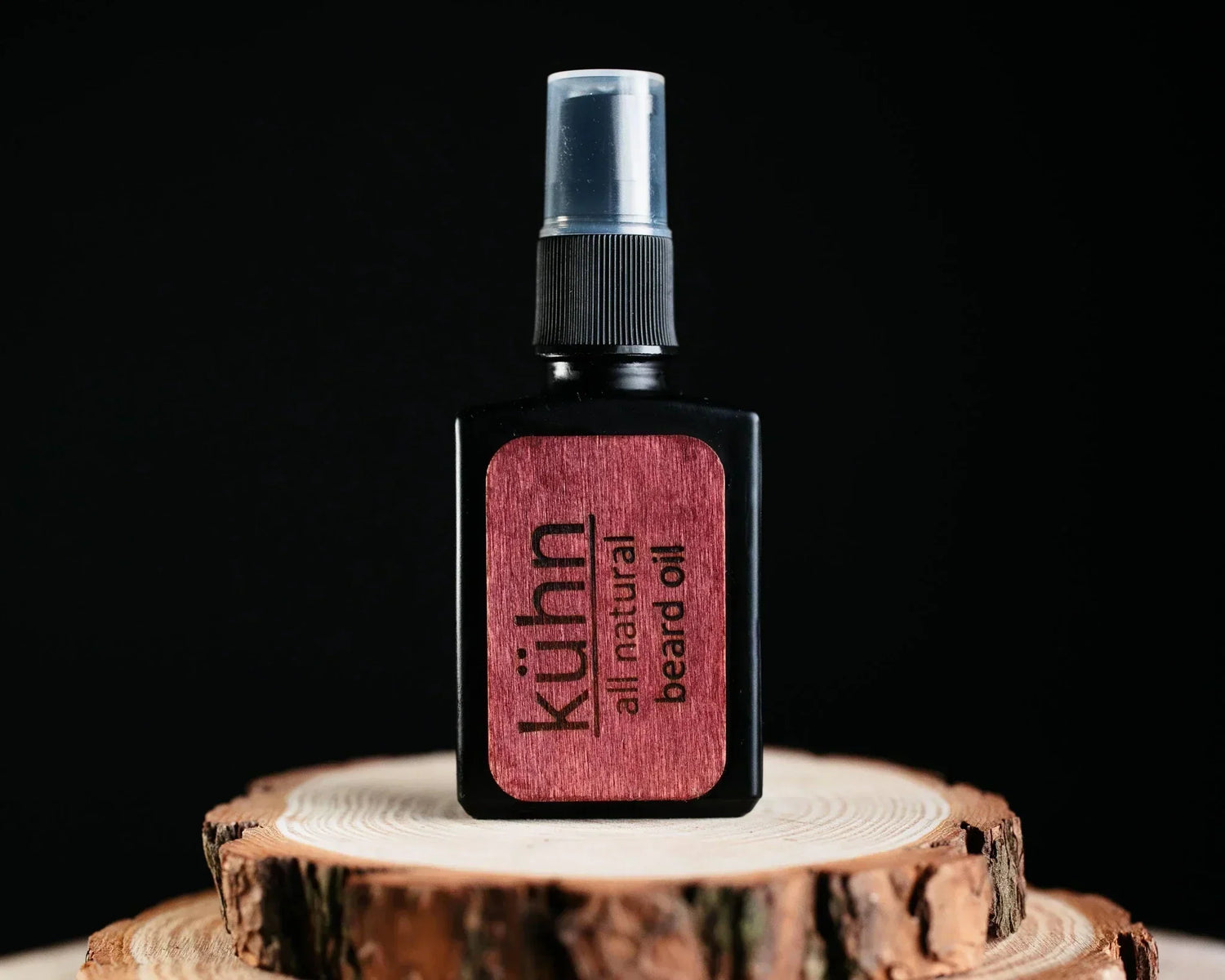
Short answer: yes — and the right formula actually helps more than it risks. Sensitive skin usually reacts to a handful of specific triggers, not to "beard oil" as a category. Once you know what those triggers are, picking (or building) a beard oil that works with sensitive skin is straightforward.
Why sensitive skin reacts in the first place
Sensitive skin has a thinner or more reactive barrier, so it overreacts to things like synthetic fragrance, drying alcohols, or harsh preservatives. Under a beard, that usually shows up as redness, itching, or flaking right where the beard meets bare skin.
A good beard oil actually works against most of that — but only if it's the right kind of oil. Most beard oils on the market are refined: cooked with heat and chemical solvents to make them shelf-stable, which also cooks out the vitamins and fatty acids sensitive skin needs most. What's left sits on top of the skin as a greasy coating instead of actually absorbing — which is a bigger problem for reactive skin, not a smaller one, since it's sitting there doing nothing but potentially irritating.
Every bottle of Kühn oil is cold-pressed instead — no heat, no solvents, five oils extracted the slow way so nothing gets destroyed:
- Shea nut oil — deep, lightweight moisture that doesn't sit heavy
- Marula oil — fast absorption, balances oil production at the skin level
- Meadowfoam seed oil — locks moisture in after the other oils do their job
- Argan oil — vitamin E-rich, softens even coarse, wiry hair
- Jojoba oil — chemically close to your skin's own oil, which is why the itch disappears
That combination matters more for sensitive skin than for anyone else: a barrier that's already reactive needs oil it can actually absorb, not oil that sits on the surface as a film.
What actually causes irritation (and what doesn't)
A lot of generic beard-care advice online tells you to avoid whole categories of ingredients — shea butter, fragrance, anything with more than five ingredients. Most of that is overcautious rather than accurate. Here's what's actually worth knowing:
Comedogenic (pore-clogging) oils are the real risk for acne-prone skin — things like coconut oil or wheat germ oil, which sit heavy on the skin and can trap dirt and oil underneath a beard. None of our oils, balms, or butters use either one. Jojoba and argan, which make up the base of everything we sell, sit at the bottom of the comedogenic scale.
Fragrance can be a trigger for genuinely reactive skin. All of our oils, balms, and butters carry a fragrance — that's core to what we make, since scent is a big part of the daily routine for most guys. If you know your skin reacts to fragrance specifically, the honest move is to patch test before committing to a full bottle (see below), the same way you would with any scented skincare product.
Shea butter gets a bad reputation it doesn't fully deserve. You'll see generic advice telling sensitive-skin readers to avoid shea butter — but shea is a well-tolerated, low-comedogenic butter that's genuinely good for barrier repair. It's the backbone of our beard balm and beard butter for a reason. If you have very oily, acne-prone skin and want something lighter, that's a texture preference, not a shea-specific sensitivity issue — and it's exactly why our beard oil (oil-based, no shea butter body) exists as the lighter option next to the balm and butter.
If you want something built specifically for reactive skin
We also make a Beard Butter with Kaolin Clay and a Beard Balm with Kaolin Clay, both formulated with sensitive skin in mind. Kaolin clay adds glide without extra oil weight, and babassu oil (lightweight, non-comedogenic) helps soothe the skin underneath without clogging pores — a good option if you want the conditioning of a balm/butter with a lighter, more matte finish.
How to patch test before going all-in
Whatever you pick, it's worth 48 hours before you commit to daily use, especially if you know your skin reacts to new products:
- Apply a small amount to the inside of your forearm or behind your ear.
- Wait 24 hours without washing it off. No redness, itching, or bumps? Good sign.
- Apply a small amount along your jawline, where your beard meets bare skin.
- Wait another 24 hours before using it on your full beard.
The bottom line
Beard oil isn't something sensitive skin needs to avoid — it's a tool that, done right, can calm irritation instead of causing it. Stick to non-comedogenic carrier oils (which is what you're getting in ours), patch test before going all-in, and if you want an even lighter, clay-based option, that's what the Kaolin Clay line is for.
0 comments