
Beard Growth Kits Don't Grow Beards. Here's What They Actually Do.
I make beard products for a living and I've never sold a growth kit. Not because I couldn't — the term gets searched about twelve thousand times a month, and I'd sell plenty. Because the name is a lie, and I'd have to look at the label every time I poured one, and no amount of money will give me a clear conscience.
So here's the honest version of what you're actually shopping for.
No topical product grows beard
Beard density is genetics. How many follicles you have, where they sit, and how thick the hair comes in were decided before you were born. Nothing you rub on your face changes that.
This isn't a controversial position. It's what a dermatologist will tell you and what the guys who make these kits know perfectly well. The word "growth" on the box is doing marketing work, not describing a mechanism.
The only topical with real evidence behind it for hair growth is minoxidil, and that's a drug with its own tradeoffs, not something in a $40 gift set. If a kit contains oils, a brush, and a comb, it isn't doing anything minoxidil does.
But guys do end up with less beard than they could have
First, the thing that I rarely see in this industry or on reddit because nobody wants to say it out loud: some men will never grow a full beard. Not with a kit, not with patience, not with anything. Patchy at week two often means patchy at week twenty, and that's genetics doing what genetics does.
That doesn't make you less of a man. The idea that a beard is a measure of masculinity is something this industry invented because it sells product, and I'd be a hypocrite to lean on it. Plenty of men can't grow one, plenty who can choose not to, and neither group is missing anything. If you've read the patchy-beard forums and come away feeling like you failed at something, you didn't. You were sold a standard that doesn't exist.
Now — here's the part that's true, and it's why these kits sell.
Most men don't lose beard to genetics. They lose it to three things:
Breakage. Dry, coarse hair snaps. A beard that breaks mid-length never reaches the length it's capable of — you're growing it and losing it at the same time, and you never see it happen.
Itch. Weeks three through six of growing a beard are miserable. The skin underneath is dry and irritated, and most guys shave it off right there. Not because they can't grow it. Because it's uncomfortable and nobody told them it passes.
Over-trimming. A beard that won't behave gets trimmed. Then trimmed again to even it out. Then again. Guys cut off months of growth chasing a shape they could have had by conditioning the hair instead.
Fix those three and you keep more of what you're already growing. That's a real, measurable difference — it just isn't growth, and calling it growth is where the industry goes wrong.
What a kit should actually contain
Three things, and that's genuinely it.
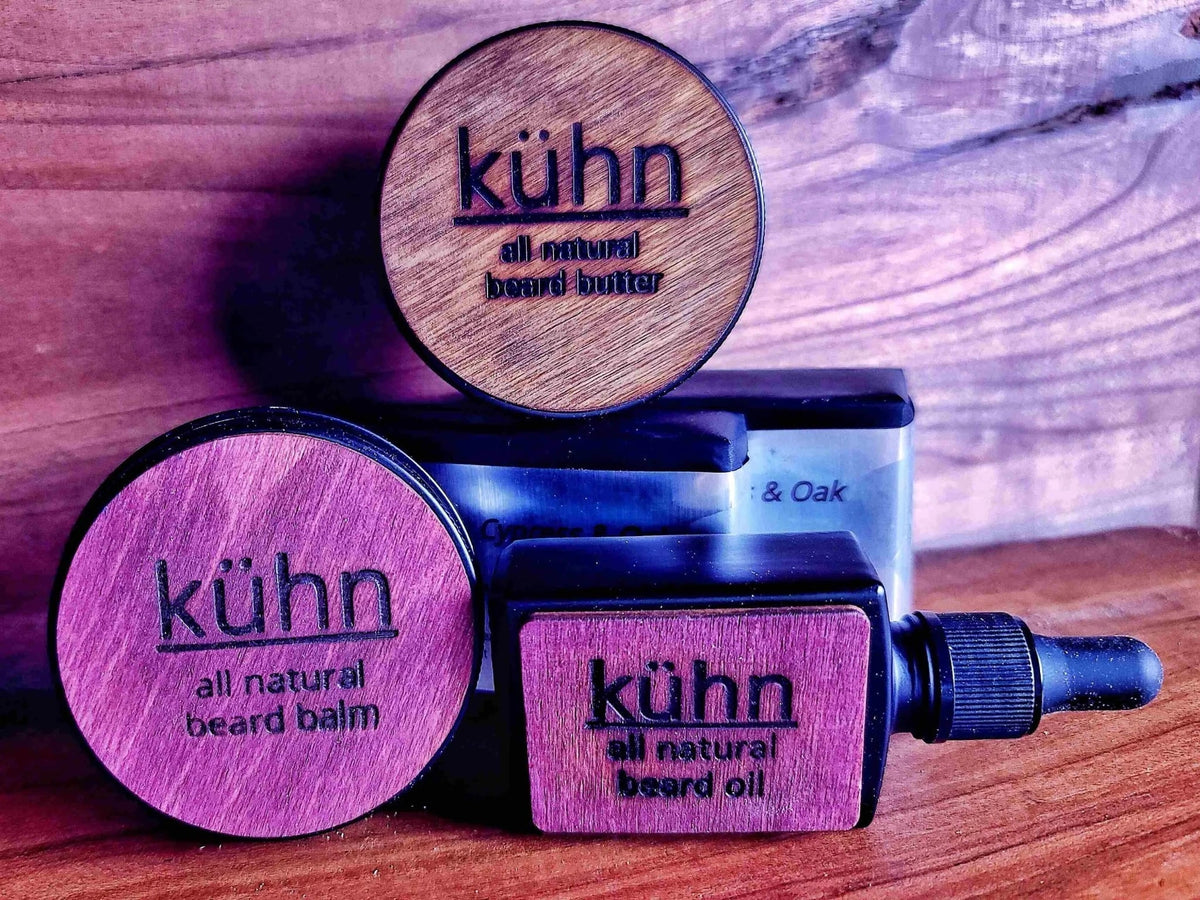
Something for the skin. This is where itch lives, and itch is what makes guys quit. A cold-pressed beard oil worked down to the skin does this — mine is five oils and a fragrance, nothing else. Short lists matter when your face is already irritated.
Something for the hair. Coarse, dry hair is what breaks. A beard butter carries fatty acids into the hair fibre in a way a thin oil can't. If your beard feels like wire, this is the piece doing the work.
A wash that isn't stripping you. The most common mistake I see. Regular soap and shampoo pull the oils out of your beard every morning, and then you spend the rest of the day asking an oil to put them back. My co-wash is flipped to 90% conditioner and 10% cleanser for exactly this.
Add a brush if you want to train the direction the hair lays. That's a styling tool, not a growth tool, and it's fine to want it for that reason.
Everything beyond that is padding. The supplements, the derma roller, the growth serum — those are there to make the box look full and I truly believe them to be a load of crap, despite any anecdotes to the contrary.
The derma roller deserves a fairer hearing than the rest, though, because there's real research behind it — it just isn't research about beards. The study everyone cites is a 2013 trial in the International Journal of Trichology: 100 men with male pattern baldness, twelve weeks, one group rolling weekly alongside twice-daily 5% minoxidil, the other using minoxidil alone. The rolling group gained roughly 91 hairs per square centimeter against about 22. That's a genuinely good result.
Read the setup again, though. That's scalp, not face. And it's minoxidil plus rolling versus minoxidil alone — nobody tested rolling by itself, and part of the proposed mechanism is that the needles help a topical absorb better. Which requires a topical worth absorbing, and there isn't one in your kit. There has never been a clinical trial of derma rolling on beards. Not one. Every claim you've read about it is borrowed from a study about a different body part paired with a drug that isn't in the box.
The newest research doesn't help the case either. A 2026 trial of 245 people over 24 weeks found microneedling added nothing over minoxidil on its own.
On beard vitamins specifically
My brother works for a company that formulates supplements, including beard vitamins for other brands. So I know how that sausage gets made.
Nearly every one of them is built around biotin, so it's worth knowing what biotin actually is.
Biotin is vitamin B7 — a water-soluble B vitamin. Its job in your body is to act as a cofactor for a handful of enzymes called carboxylases, which handle fatty acid synthesis and amino acid metabolism. That second one is where the hair connection comes from: your hair is made of keratin, keratin is built from amino acids, and biotin is part of the machinery that processes them.
So the logic isn't invented. If you don't have enough biotin, that machinery runs badly, and one of the visible symptoms is hair thinning and brittle nails.
Here's the part the label doesn't mention: biotin deficiency is rare. Your gut bacteria produce some, and it's in eggs, nuts, seeds, salmon, sweet potatoes, and organ meats. The adequate intake for an adult is around 30 micrograms a day, and a normal diet clears that without trying.
The people who actually run short are a short list — those with a genetic condition called biotinidase deficiency, people on long-term anticonvulsants or antibiotics, heavy drinkers, and the genuinely odd case of people eating large amounts of raw egg white, which contains a protein that binds biotin and blocks absorption.
If you're not in that list, you almost certainly have enough.
And the doses in beard supplements are absurd. A typical one contains 5,000 to 10,000 micrograms — somewhere between 160 and 330 times what you need. Biotin is water-soluble, so your body doesn't store the excess. It goes out in your urine. That's the whole mechanism of a $35 bottle.
One thing genuinely worth knowing, because almost nobody mentions it: high-dose biotin interferes with common lab tests. It can skew thyroid panels and, more seriously, troponin tests — the ones used to diagnose a heart attack. The FDA has issued warnings about it. If you're taking a high-dose biotin supplement, tell your doctor before bloodwork.
There's nothing wrong with a multivitamin. There's something wrong with selling one as a beard growth product.
What actually moves the needle
Ranked by how much difference it makes, in my experience selling at farmers markets and talking to a few thousand guys:
- Patience. Beards grow roughly half an inch a month. The awkward stage is real, it lasts weeks, and it passes. Most guys quit inside it.
- Leave your neck alone. The single most common mistake. The hair below your jaw is what gives a beard fullness. Shave it to tidy up and you lose the body — what's left hangs off your cheeks.
- Fix your wash. Before you buy anything else.
- Condition it. Less breakage, less itch, less reason to quit.
- See a barber before you see a razor. Sixty dollars for a proper shape-up saves months of self-inflicted damage.
None of that is a product you can buy in a kit. Points three and four are, which is the honest case for buying one.
So should you buy a kit at all?
Yes, if what you want is the three things above in one box at a lower price than buying them separately. That's a real reason and I sell kits on exactly that basis.
No, if you're buying it because the word "growth" is on it. That part isn't going to happen, and I'd rather tell you now than have you disappointed in six weeks.
If you're just starting out, I'd genuinely rather you read this first than buy anything.
Common questions
Do beard growth kits work? They don't grow beard. They can help you keep more of the beard you're already growing by reducing breakage and the itch that makes people quit. That's worth something — it just isn't what the name promises.
Does beard oil help beard growth? Not directly. It conditions the skin and hair, which reduces breakage and irritation. Guys who stick with a beard usually end up with more beard than guys who shave it off in week four, and comfort is a big part of sticking with it.
What about beard growth serums? Depends entirely on what's in it. If it's oils with "growth" on the label, it's a beard oil with better marketing. If it contains minoxidil, that's a drug and worth a conversation with a doctor rather than a purchase decision.
Do beard vitamins work? Only if you're deficient in what's in them, and most people aren't. Biotin — vitamin B7 — is the usual centrepiece. It's a real cofactor in the amino acid metabolism that builds keratin, so the reasoning isn't made up, but you need about 30 micrograms a day and a normal diet covers that easily. Beard supplements typically contain 5,000 to 10,000. It's water-soluble, so the surplus leaves in your urine.
Is high-dose biotin safe? Generally, yes, in the sense that it isn't toxic. But it does interfere with lab tests — thyroid panels and troponin tests especially, which are what doctors use to diagnose a heart attack. The FDA has warned about this. Tell your doctor if you're taking it before any bloodwork.
How long does it take to grow a full beard? About half an inch a month, so a substantial beard is months of work rather than weeks. The awkward stage is normal and temporary.
What if my beard is patchy and nothing helps? Then it's patchy, and no product changes that. Some men grow full beards, some grow patchy ones, some can't grow one at all — it's follicle distribution, decided before you were born. A shorter length often looks better on a patchy beard than a long one, since length exaggerates the gaps. But there's no fixing it, and there's nothing to fix about you either.
What's the single best thing I can do for my beard? Don't shave your neck, and don't quit during week four.
If you want the three things that actually help in one box: beard kits and bundles.
I formulate, mix, pour, and label every Kühn product myself in Utah. Questions go straight to me — email me.
0 comments