

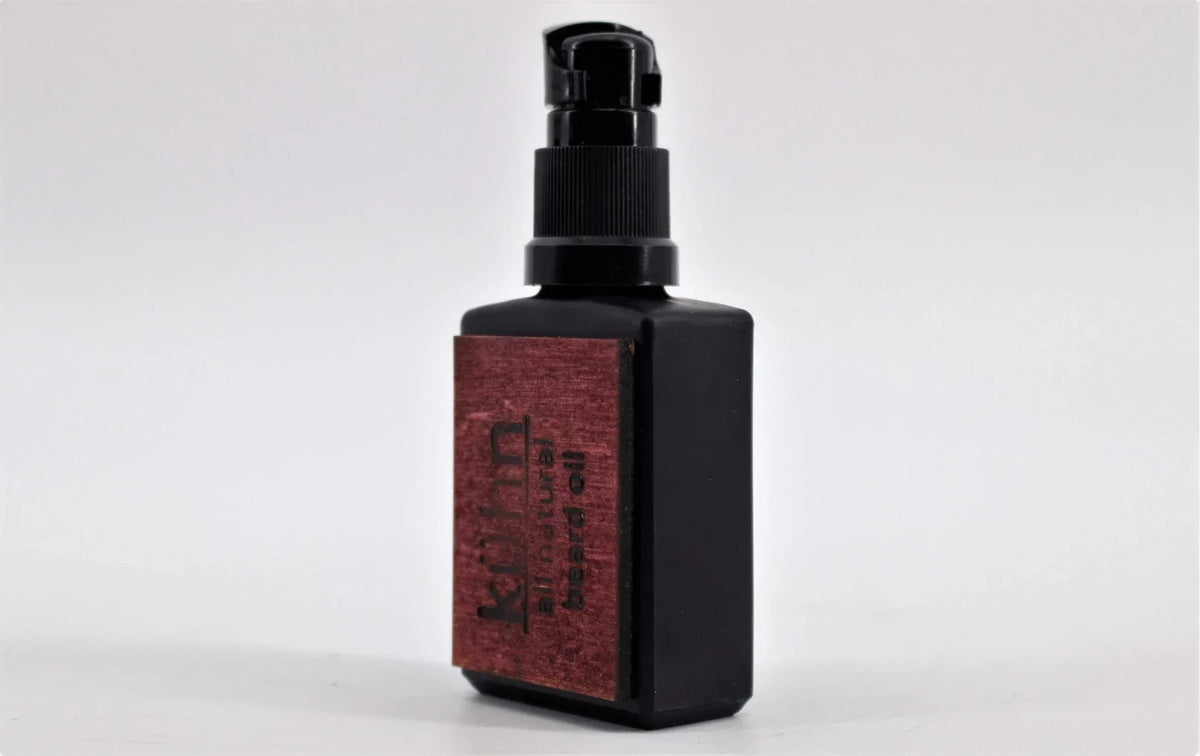
If your face reacts to things, you've probably already been through a few beard oils. One made you red. One made you itch worse than going without. One seemed fine for a month and then didn't.
I make beard oil for a living, so I've thought about this more than is reasonable. Here's what I've landed on.
Sensitive beard skin usually isn't an allergy
That's the first thing worth saying, because "sensitive skin" gets treated like a diagnosis when it's usually a description.
The skin under a beard takes more abuse than the rest of your face. It's covered, so it doesn't dry the way exposed skin does. It gets friction all day from your collar, your hands, your pillow. And you can't wash it properly — most face washes never make it through the hair.
That combination leaves the skin barrier worn down. Worn-down barrier reacts to things it wouldn't otherwise react to. So a product that would be perfectly fine on your forearm makes your jaw go red.
Which means the fix usually isn't hunting for the one magic hypoallergenic product. It's giving the barrier fewer things to deal with.
Why ingredient count matters more than ingredient claims
Every ingredient in a formula is another thing your skin has to tolerate. That's the whole logic.
A typical drugstore beard oil runs fifteen to twenty ingredients — a base oil or two, then fillers, silicones, synthetic emollients, preservatives, and a fragrance blend that's itself a dozen compounds hiding under one word.
Mine is five oils and a fragrance. That's the entire list:
- Cold-pressed shea nut oil — lightweight moisture that doesn't sit heavy
- Cold-pressed marula oil — absorbs fast, balances oil production at the skin
- Cold-pressed meadowfoam seed oil — locks the others in once they've done their work
- Cold-pressed argan oil — vitamin E rich, softens coarse hair
- Cold-pressed jojoba oil — chemically close to your own sebum, which is why the itch settles
No silicones. No fillers. No butters or wax, which is what separates my beard oil from my balm and butter — those need beeswax and shea to hold their form.
If your skin is reacting to something, a five-ingredient list is a much shorter list to work through than a twenty-ingredient one.
Cold-pressed matters here specifically
Most carrier oils on the market are refined — extracted with heat and chemical solvents to make them cheap and shelf-stable. That process also cooks out a chunk of the vitamins and fatty acids, and leaves solvent residue behind.
For most people that's a quality issue. If your skin is reactive, it's more than that: you're putting residue on a barrier that's already struggling.
Cold-pressing is slower and costs more. It's also the reason I can list five ingredients instead of hiding a process behind a marketing word. I've written a longer piece on refined vs cold-pressed if you want the detail.
Jojoba is the one worth knowing about
Of the five, jojoba is the one that matters most for reactive skin, and it's worth understanding why.
Jojoba isn't really an oil — it's a liquid wax ester, and its structure is unusually close to human sebum. Your skin recognizes it. That's why it absorbs instead of sitting on top, and why it tends not to trigger the response heavier oils sometimes do.
More on it here.
The fragrance question, honestly
Fragrance is the most common sensitizer in cosmetics. I'm not going to pretend otherwise on a page where I'm selling you scented beard oil.
Here's how I actually think about it.
The scent is the point of these products for most people, and I make fifteen scent profiles because that's a real part of why guys enjoy using them. I'm not going to tell you to give that up on the assumption you're reacting to it.
But if you know fragrance is your problem — you've reacted to scented products before, you've had a patch test come back — I make the same five-oil formula unscented. Same oils, same cold-press, fragrance removed. It exists for exactly this reason.
And if you don't know whether fragrance is your issue, that's what the sample pack is for. Five scents, small bottles, cheaper than guessing wrong on a full-size.
What I'd actually try, in order
Start with the wash. This is the one most guys skip. If you're washing your beard with regular soap or shampoo, you're stripping the barrier every morning and then asking the oil to repair it by lunch. My co-wash is flipped to 90% conditioner and 10% cleanser for this reason. Fixing the wash sometimes fixes the "sensitivity" on its own.
Then simplify. One product, five ingredients, nothing else on your face for two weeks. If it settles, you know. If it doesn't, you've narrowed it a lot.
Then patch test properly. Inside of your elbow, twice a day, five days. Boring, but it beats another round of trial and error on your face.
If you want hold as well, my clay balm is the one I'd point you at. Kaolin clay for structure instead of leaning on heavier waxes, and a matte finish rather than shine.
What I'm not going to tell you
I'm not going to call any of this hypoallergenic. That word means almost nothing — there's no standard behind it, and anyone can print it on a bottle.
I'm also not going to tell you a beard oil fixes eczema, seborrheic dermatitis, or anything else with a name. Those are things to take to a dermatologist. What a good oil does is stop making it worse, which for a lot of guys is most of the problem.
Common questions
Can beard oil cause a reaction? Any topical product can. The usual suspects are fragrance, preservatives, and nut-derived oils. Shorter ingredient lists give you fewer variables to work through.
Is unscented better for sensitive skin? Not automatically. Fragrance is the most common sensitizer in cosmetics, but plenty of people with reactive skin use scented products with no trouble. It's worth trying unscented only if you have reason to think fragrance is your specific problem.
Does cold-pressed actually matter? For quality, yes — you keep the vitamins and fatty acids that heat extraction destroys. For sensitive skin specifically, it also means no solvent residue.
Why is jojoba in almost every beard oil? Because its structure is closer to human sebum than any other common carrier oil, so it absorbs rather than coating.
I'm using oil and my beard still itches. What now? Look at your wash before you look at your oil. Stripping the skin every morning undoes whatever the oil does the rest of the day.
Do I need a separate product for the skin versus the hair? Not necessarily. A cold-pressed oil worked down to the skin does both. If you want actives beyond conditioning, that's what ELEMENT is for.
Everything above is in the beard oil collection, scented and unscented.
I formulate, mix, pour, and label every Kühn product myself in Utah. Questions about what's in something go straight to me — email me.
0 comments